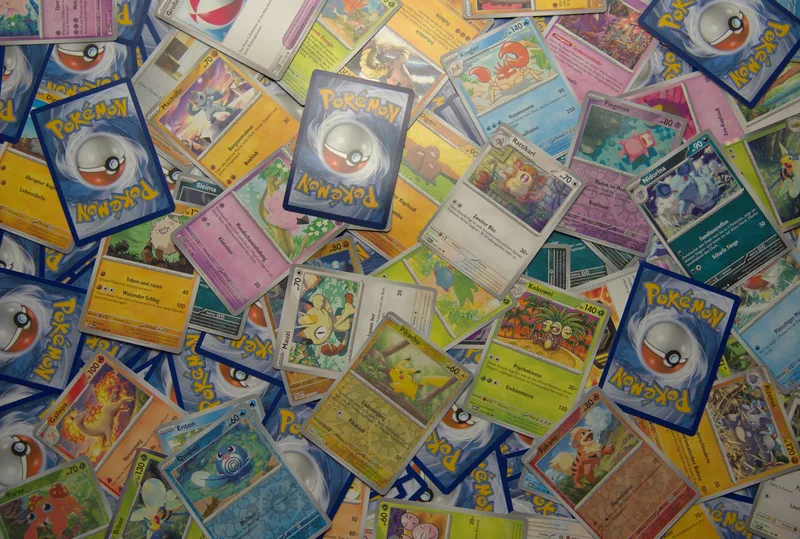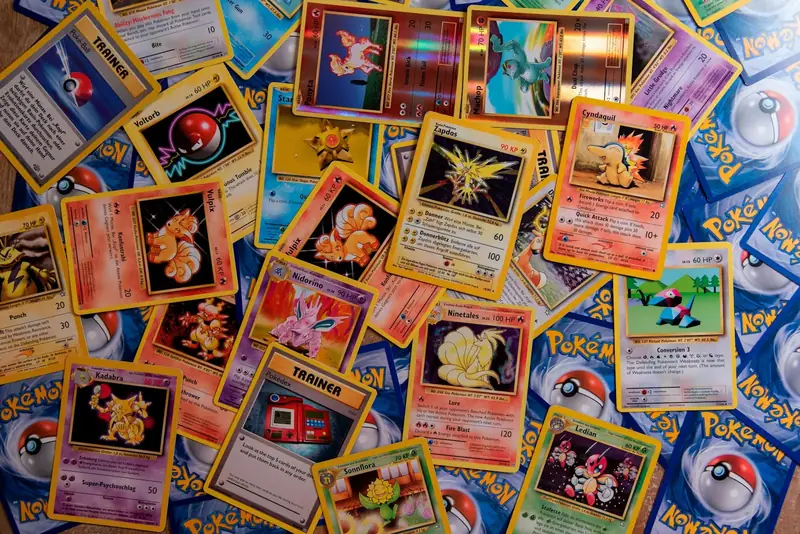
Learning how to sort bulk Pokemon cards is the difference between two cents a card and two dollars a card, and both of those numbers are usually on the same buylist. There is no shortcut around it: buylists pay one rate per category, and several of them have no unsorted rate to fall back on at all, so the pile a card sits in is the price it gets. This post is how to build those piles in one pass. The category figures used as examples are typical published rates read in September 2026, not an offer: we no longer buy bulk ourselves.
The sort itself is one pass down the box. You do not need sleeves, a spreadsheet, or any knowledge of what a card is worth. You need a table, an hour per thousand cards, and the willingness to touch every card once.
How to sort bulk Pokemon cards: one pile per rate line
The instruction is exactly as simple as it sounds. Sort by the line of the rate table a card falls under. Every ex together, every non holo rare together, every holo rare together, and so on down the board. Basic energy comes out first and is not a pile at all: we do not buy it, and it is postage weight and nothing else.
Commons and uncommons, $20 per 1,000. Circle or diamond by the set number, artwork flat. Everything left over lands here, and that includes non holo Trainers, which are counted on this line at this rate.
Non holo rares, $30 per 1,000. A black star by the set number, and the artwork still stays flat.
Holo and reverse holo, $50 per 1,000. One pile for both. If the artwork shines or the border shines, it belongs here, and you do not have to tell the two apart because they share a rate line.
Cosmos holo, $100 per 1,000. This is the one pile decided by the foil pattern rather than by a word or a symbol, so it is the one that needs a lamp. Tilt a holo and look at what the shine is made of: scattered dots and rings of different sizes across the picture, like a starfield, means a cosmos holo, and it goes here rather than in the pile above at double the rate. Straight lines, one flat sheet, or a shine confined to the border are not this pile. Cosmos was the standard holo pattern from Base Set 2 in 2000 until Black and White in 2011, and it still shows up on promos, so it is common enough in an old box to be worth the second look.
Then one pile for each category paid by the card. Amazing Rares and baby shinies at 50 cents. VMAX and VSTAR at a dollar. The GX, EX and V class, full art Pokemon and full art Trainers all at 75 cents, and any Pikachu V, VMAX or ex on its own Pikachu line at 75 cents too. Gold foil secret rares at $1.25. Trainer Gallery cards, Illustration Rares and rainbow foil ultra rares are the exception to the whole board: those pay 80 percent of the card's TCGplayer market value, priced when we count the box, floored at a dollar and two dollars a card. They are also the only lines where a card below Near Mint is not paid at all, so keep those three piles clean.
That last group is the whole reason to sort. Those cards are a rounding error in a monster box by count and a third of the money by value.
The shine pile is the one people forget
Leaving the shines in the commons pile is the most common sorting mistake that arrives in a box here, and it is an expensive one. A reverse holo common pays 5 cents in its own pile and 2 cents in the commons pile. Same card, two prices, decided entirely by which stack you put it in.
The tell is just that something shines. On a holo rare the artwork shines and the rest of the card is matte. On a reverse holo it is the opposite: the border and the text box shine, the art box does not. That distinction used to be worth money and now it is only worth knowing, because both land on the same line. Tilt the card under a lamp. If anything catches the light, it is a 5 cent card, not a 2 cent one.
The rule that still moves real money is the higher value category rule: when two categories could describe one card, the higher one wins, and we apply it in your favor on the recount. A full art Trainer is not a common at 2 cents, it is a full art at 75 cents. A shiny common is not a common.
Trainers go in with the commons
Non holo Trainers used to have their own cheaper line here. They do not any more. A Trainer with a circle or a diamond by the set number is counted with the commons and uncommons at the same $20 per 1,000, so there is no Trainer pile to build and nothing lost by not building one.
The exception is the one above. A Trainer wearing full art framing is paid on the full art line at 75 cents, a Trainer Gallery Trainer is paid at 80 percent of its market value with a dollar as the floor, and a gold Trainer is paid at $1.25. That is worth catching, because it is the same 40 to 100 times difference the shine pile hides. The tell for those is the framing, not the word TRAINER: read the artwork, not the header.
How to store bulk Pokemon cards once they are sorted
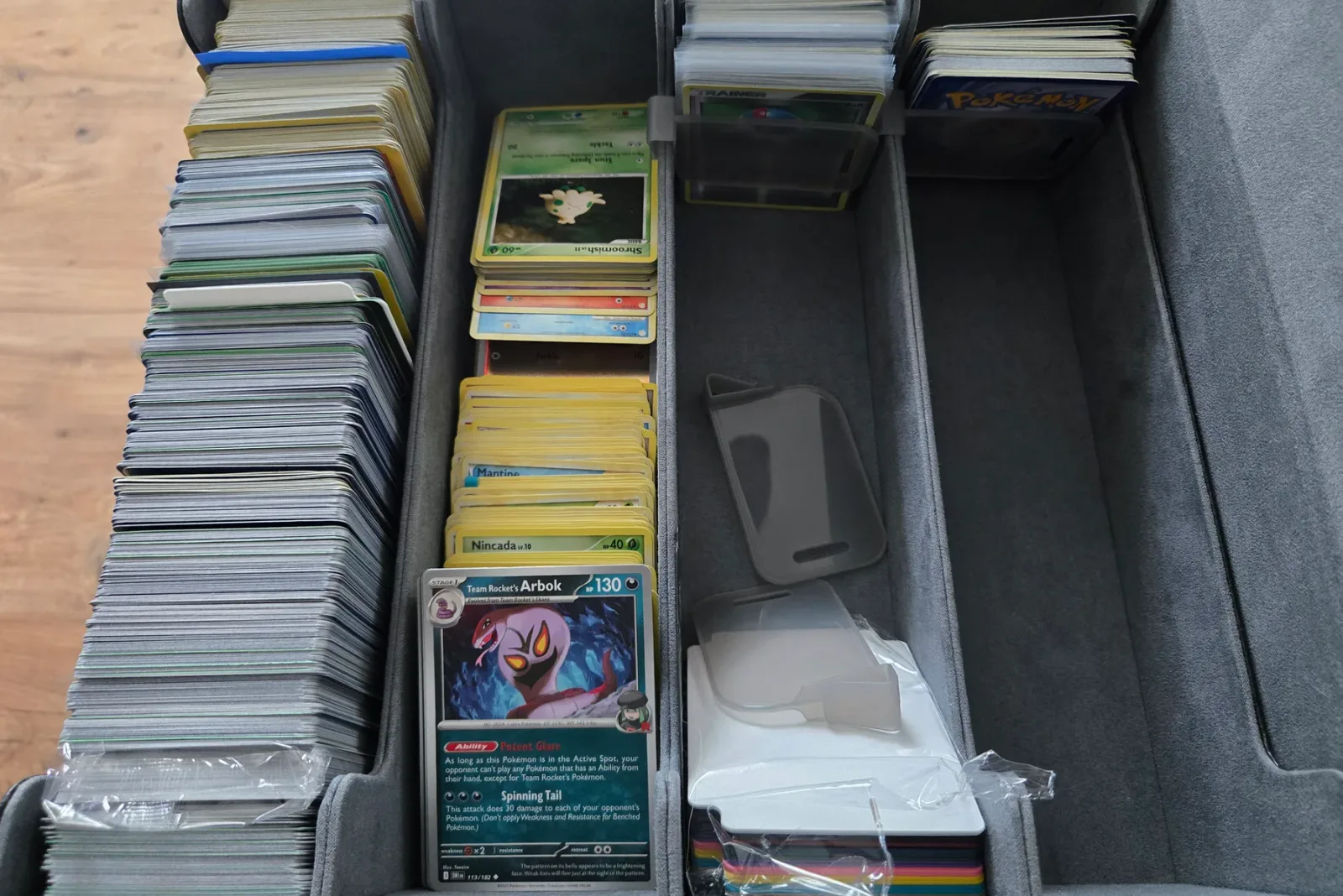
Sorted bulk stays sorted only if it goes somewhere with walls. Band each pile in hundreds, because a banded hundred is countable at a glance and a loose pile is not, and our recount goes faster when yours is already countable. Rubber bands are fine on bulk; they are not fine on anything from the per card lines, which should go into toploaders or a team bag instead.
For storage between sorting sessions, a multi row cardboard storage box does the whole job for a few dollars. Keep it off the floor and out of a garage. Humidity warps cards, and a warped card drops out of Near Mint, which drops it out of the rate you just spent an hour earning.
These piles are the right shape whoever you sell to, because the categories are near enough standard across buylists. Check your buyer's own category list before you pack, since a shop that splits or merges a line will want the piles to match it. We are not buying bulk by mail any more, so this guide points at your rates, not ours.
What sorting is actually worth
Run the arithmetic on a realistic monster box of 5,000 cards. Say 100 basic energy comes out first, then 4,100 commons and uncommons, 350 holos and reverse holos, 50 cosmos holos, 300 non holo rares, and 100 cards across the per card lines at an average of 80 cents each.
That is $82, $17.50, $5, $9 and $80, so $193.50 for the box. The hundred cards you pulled off the top are two percent of the count and over forty percent of the money, and they took about ten minutes of the evening.
Those pile sizes are an illustration, not a measurement of your box. The rates are not: they are our live published numbers on 7 September 2026, and they move, which is why we keep the current bulk price guide updated at one address instead of scattering dated numbers across posts.
The honest caveat is time. An hour per 1,000 cards is a fair pace for a first sort, faster once your eye stops reading cards and starts catching light. At the 5,000 card box above you are earning about $39 an hour, and far more than that for the ten minutes spent pulling the per card lines. If you only ever do one pass, do that one.
FAQ
How long does it take to sort 1,000 Pokemon cards?
About an hour for a first sort, and closer to 30 or 40 minutes once you can spot a shine by tilt rather than by reading the card. The pass for the per card lines is much faster than that, roughly ten minutes per thousand, because you are only looking at the name line and the framing.
Do I have to sort bulk before selling it?
Yes. We publish one rate per category and there is no separate unsorted rate, because the count is the categories: a pile nobody has separated cannot be counted as the category it belongs to. It is one pass down the box rather than five, and on the arithmetic above it is the best paid hour in the hobby.
What counts as bulk versus a single worth selling on its own?
Anything reliably worth a dollar or more on its own is a single, not bulk, and it earns more listed individually than counted by the thousand. That is most of the per card lines once you check them. Cards below that line are worth more as counted bulk than as listings nobody buys, and you can see what specific cards sell for on our Pokemon singles pages.
Does condition matter for bulk?
Yes, at the edges. Bulk rates assume Near Mint English cards, and a pile with heavy play wear, creases, or water damage gets counted down. Bent corners and scuffed backs are the two we see most. Pull the obviously damaged cards out before you count; they do not pay, and they slow the recount for everything behind them.